


- About us
- Services
- E-Commerce Development
- White Label Marketing
- Digital Marketing
- Mobile App Development
- Other Services
-

In today’s competitive digital space, building a strong brand goes far beyond just creating a nice logo or catchy tagline. Your clients want results. They want to see the numbers. They want transparency. That’s where white label reporting steps in as your secret weapon.
Whether you’re running an SEO agency, a digital marketing firm, or providing design and development services, using white label reporting can significantly boost your brand’s credibility, professionalism, and client retention. But how do you use it to truly enhance your brand value?
Let’s break it down and explore how white label reporting can become the silent engine behind your brand’s success.
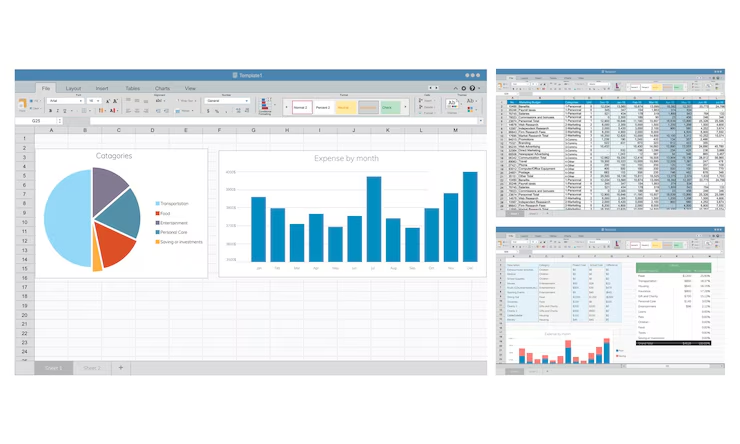
White label reporting refers to data reports created by a third-party tool or service provider but branded with your business name, logo, and colors. These reports provide clients with performance metrics—like SEO rankings, ad spend, conversions, traffic data, and more—while keeping your branding front and center.
In simpler terms: it looks like you did all the hard work, even if the data comes from outsourced tools or partners.
Your brand isn’t just about visuals; it’s about trust. Every time a client interacts with your business, they’re either building more trust—or losing it. Reporting is one of those critical touchpoints. With white label reporting, you:
In essence, your clients see you as the go-to expert without knowing what’s happening behind the scenes.
Branding is all about consistency. Your website, emails, proposals, and even your reports should carry the same look and feel. White label reporting allows you to:
Imagine your client receiving monthly SEO or PPC reports that perfectly match your website aesthetic. That kind of consistency sticks and elevates your agency to “premium” status.
Let’s be real—most agencies outsource at least some of their services, especially analytics or SEO. With white label reporting, the client never needs to know that.
You get access to beautifully formatted, data-rich reports—created by software or experts behind the curtain—but presented under your brand. This positions you as the strategist and problem solver. You own the conversation.
They see you as the one driving the results. And that means better client retention.
Nobody loves spending hours compiling spreadsheets and charts for every client. With the right white label reporting tools, you can automate:
Now, instead of data entry, your team can focus on interpreting the results and building actionable strategies. You become less of a “service provider” and more of a growth partner.
Trust is built with transparency. Clients want to see what they’re getting in return for their money—and they want it regularly.
White label reporting lets you deliver that clarity. When clients receive detailed, branded reports showing measurable KPIs—like keyword movement, conversions, or ROAS—they’ll feel more confident in your work.
Better yet, they’ll be less likely to question your invoices when they can see exactly how their investment is performing.
Let’s face it: most clients aren’t experts in digital marketing. They don’t always understand what CTR or bounce rate means. The beauty of white label reporting is that you can:
This educates your clients over time, making them more appreciative of your value. An informed client is a loyal client.
One of the main reasons clients leave agencies is because they “don’t see results.” Sometimes, it’s not that you’re not delivering—it’s that you’re not showing it clearly enough.
White label reports allow you to present monthly (or even weekly) progress in a digestible, branded format. When clients can track their growth over time—backed by your expert commentary—they’re far more likely to stay.
Every client is different. Some want an in-depth look at technical SEO; others care only about sales conversions.
With white label reporting, you can tailor each report to highlight the metrics that matter most to each client. For example:
Customized reports show that you understand their business—and that boosts satisfaction.
If you’re growing your agency, reporting can become a bottleneck. Manually creating reports for 10 clients is manageable. But what about 100?
White label reporting automates and scales with you. With tools like AgencyAnalytics, DashThis, or ReportGarden, you can:
This scalability allows your agency to grow without increasing internal workload.
Sometimes the decision-makers aren’t just your direct clients, but their stakeholders—like investors, board members, or internal teams.
A clean, professional, white-label report is more shareable and makes a stronger impression in those internal meetings. It shows your client’s stakeholders that they made a smart investment by working with you.
Think reports are just for existing clients? Think again.
Use branded white label reports during your sales process to:
When potential clients see the professionalism and clarity of your reporting, it builds trust early in the buying journey—and that gives you an edge over your competitors.
At the end of the day, white label reporting is more than a convenience—it’s a brand-building powerhouse. It enables you to maintain a consistent, professional identity while delivering real value to clients. From automating your workflow to enhancing communication and retention, it plays a crucial role in scaling a successful agency.
If you’re not already using white label reporting, now’s the time to start. It’s like putting your agency’s best foot forward—every single month.
White label reporting is when you use third-party tools or services to generate performance reports but customize them with your own branding (logo, colors, etc.) so it appears the work is coming directly from your agency.
Any agency offering digital marketing, SEO, PPC, social media, or web design services can benefit. It’s especially valuable for client-facing businesses.
Absolutely. Most tools allow you to tailor metrics, timeframes, and comments to each client’s specific goals.
Most white label reporting tools are subscription-based and offer scalable pricing depending on the number of clients or features. It’s often much cheaper than building custom reports in-house.
Monthly is the standard, but some high-volume clients may benefit from weekly updates. The key is consistency and clarity.
© Copyright 2026 F5 Buddy Pvt. Ltd.. All Rights Reserved
 Career
 Woo-Commerce
